Project planning and estimating
Clarify scope, quantities, production, materials, risk and the plan behind a workable heavy-civil project.
E³I provides heavy-civil project-management consulting for the work your project needs. Bring in the team for planning, estimating, field operations, project controls, recovery, reconciliation, or the hard decisions between them.
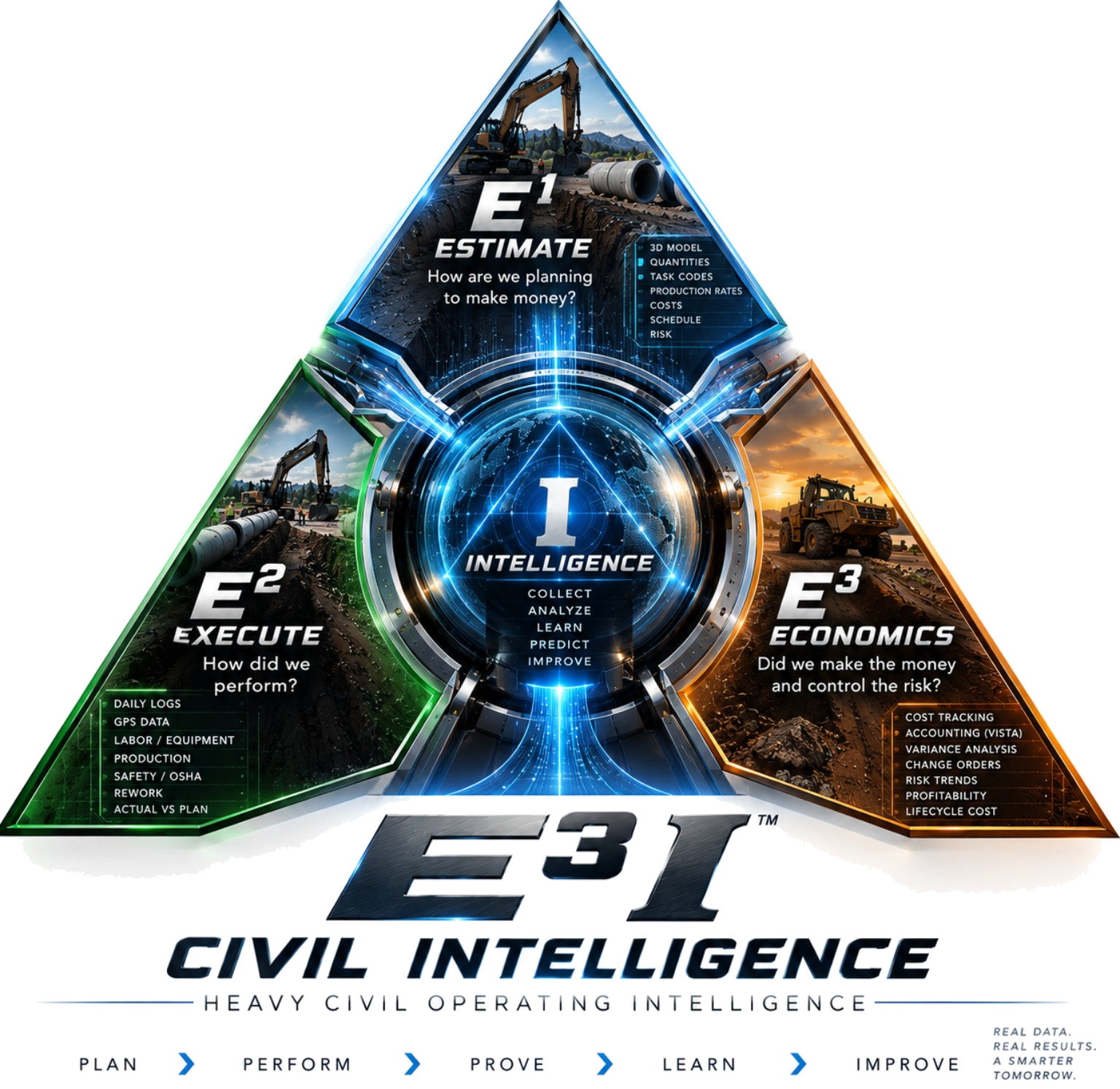
E³I joins your team where the project needs stronger control, clearer direction, or experienced support. The consulting engagement is shaped around the job, not a one-size-fits-all package.
Clarify scope, quantities, production, materials, risk and the plan behind a workable heavy-civil project.
Support crews, production planning, work sequencing, equipment, material movement, documentation and changing field conditions.
Bring structure to a job that is drifting: identify the condition, rebuild the working plan, and create a practical path forward.
Connect actual production, material, cost and revenue so the project finishes with a clear financial record and usable lessons.
Existing conditions, proposed grades, utilities, material zones and production areas start as a usable job model.
Guided equipment gives the operator the live grade, location and production target needed to build with control.
Installed work, hours, material movement and changing conditions become the evidence behind the next decision.
The loop starts with the plan set. Careful plan review and 3D modeling decipher the work into a usable representation: surfaces, utilities, materials, production areas and task-code logic. AI then organizes, questions and connects that evidence so the Triangle can carry the job from estimate through field production and financial reconciliation.
Build existing and proposed surfaces, grades, quantities, utilities, materials and production areas from plan and field data.
Translate plans, specifications, model outputs and job records into questions, task structures, checks and usable operating information.
Connect quantities and modeled conditions to task codes, resources, production assumptions, materials and risk.
Track actual installed work, crews, equipment, material movement, constraints and change conditions.
Compare the baseline to actual production and economics, then return verified knowledge to the next GPS model and estimate.
AI connects the project record as it moves: plans and specifications become model inputs; the model becomes the estimating and field basis; actuals return as proof for the financial result.
Plans, specs, survey, geotech, addenda and field records.
TRACE SOURCESSurfaces, utilities, materials, production zones and conditions.
LINK GEOMETRYMap task codes, find gaps, compare sources and draft questions.
FLAG VARIANCEPublish field-ready tasks, model targets and daily work plan.
GUIDE WORKInstalled work, hours, equipment, materials and conditions.
RECORD ACTUALSReconcile cost, revenue and production into the next baseline.
IMPROVE NEXT BIDEach point supplies what the other two need. Estimate gives the field a usable production basis. The field supplies the facts. Economics proves the result and sends the verified lesson back into the next bid.
Scope, quantities, task codes, materials, equipment and planned production.
Installed work, hours, equipment, conditions, changes and material movement.
Actual cost, revenue, risk, margin and the verified reason behind the variance.
The Triangle keeps the same task alive from the first takeoff through the last reconciliation. Intelligence links the source plans, modeled quantities, production assumptions, field evidence and financial result so the team can see what changed, why it changed and what the next decision needs.
The same system that shapes the logo shapes the work: establish the estimate, capture execution, and reconcile economics before the knowledge disappears.
Model the work, quantify every production task, price the resources, and build a field baseline the team can actually run.
Put the latest model and production target in the field, guide equipment, and capture the work as it is installed.
Reconcile actual hours, equipment, material movement, cost and revenue so the next decision is based on proof.
Every point in the Triangle carries the evidence needed by the next. The operating loop keeps those handoffs visible and makes the job teach the company.
When the estimate, field record and financial review describe the same task the same way, the team can find the reason behind performance instead of just finding a number after the job is over.
Every activity starts with quantities, resources, conditions and a field-ready target.
Daily actuals and changing conditions become useful evidence instead of forgotten context.
Financial reconciliation identifies the real driver and carries it into the next estimate.